
MFB-synth II, mp3 sound samples (192 kbps)
Demo
song -
Multitracked in computer with panning, reverb and some delay, no other
effects.
All sounds come from the MFB-synth II, even drums and percussion.
Bass
- Based on preset Typical (no.01)
Tweaking Cutoff and Emphasis, using other sequenser to show velocity.
Random
- preset S&H Filter (no.27)
Glide,tweaking Cutoff and MOD.VCF, played from keyboard.
MindScanner
- preset Mind Scanner (no.13)
Tweaking Cutoff, Emphasis and Audio-In (the Minimoog trick), played from
keyboard.
RingSync
- sync-sound with 2 RingMods
Tweaking VCO2, VCO3, Audio-In and Emphasis, using other sequencer to show
velocity.
PWM
- only VCO3 with square wave
Tweaking PWM, Cutoff, Decay and Emphasis,
using other sequencer to show velocity.
User Manual - The official in English.
MIDI implementation - The official in English.
Go to the official MFB products page.
MFB-synth2 user group tips & tricks.
MoogulatoR's MFB-II test (in German) and audio demo, lots of images too.
Copyright
©1998-2004 Unease.
The images, mp3s and text on these pages may not be used anywhere else
without written permission.
MFB-synth
II
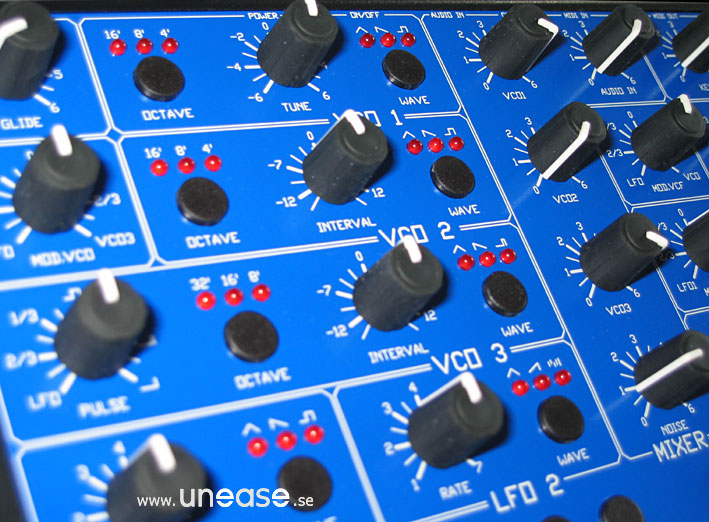
The new MFB-synth II is a major update of the rather limited original MFB-synth (We will refer to it as MFB-I). From the look you immediately see that 18 knobs have turned into 29 and it pretty much gives you an idea of how much have happened. What the eye won’t notice is the patch memory, 50 factory presets and 49 user presets. Even if it doesn’t improve the sound a little bit, it sure is a blessing making this machine very convenient to operate. The step sequencer is still working the same way with up to 32 steps and will transpose to the key you play, but now it is also possible to store 25 patterns. Worth noting is that MFB-II is squeezed into the same little plastic desktop box as the MFB-I (315 x 165 x 38/75 mm), any pro or home studio should be able to make room for it.
Functions
Sound wise the MFB-II has a pure analogue signal path (VCO, VCA &
VCF) with three VCOs (VCO3 doubles as LFO) and a Moog-type 24 dB/octave
lowpass filter, all just like Minimoog and MFB-I. However the MFB-II could
Sync VCO2 to VCO1 and VCO3 has PWM. All VCOs have triangle, sawtooth and
square waveforms. The pitch of VCO1 & -2 ranges from 4’-16’
and for VCO3 8’-32’, also VCO2 & -3 could be detuned by
+/-1 octave.
Compared to MFB-I the VCO3 now operates one octave lower to improve bass
sounds. With a shift click VCO2’s & -3’s Interval-knobs
doubles as ring modulation adjuster (VCO1*VCO2 and/or VCO2*VCO3). The
ring modulation is digital.
Among the most important new features are the two stand alone LFOs which modulate VCO, VCA or VCF. LFO1 offers triangle, sawtooth (falling) and square, while LFO2 triangle, sawtooth (rising) and random (yes!). The LFOs could be set to one-shot mode and work like mini-envelopes, i.e. they only play the waveform once and re-trigger each time you press a key. In the mixer part there is a knob to adjust the level of each VCO, the noise generator and Audio In. If there is nothing connected to the Audio In, the output of VCA is fed back to the filter in a Feedback loop, i.e. you don’t need any cable to do the Minimoog-trick! It is all done internally and the Audio In-knob adjusts the level, very clever little feature.
The filter controls
consist of Cutoff (frequency), Emphasis (resonance, will self-oscillate)
and Contour (amount). So far it is the same as MFB-I but Manfred Fricke
has also added a Key-knob (keyboard follow). The filter envelope (ADSR1)
now has a separate knob for Release which was not the case with MFB-I
and others like Minimoog and Moog Prodigy. Like you would expect it works
just the same with the VCA envelope (ADSR2).
There is three different modulation knobs; MOD.VCO, MOD.VCF, and MOD.VCA,
to adjust the modulation intensity. These knobs are bipolar controls with
different functions depending on left or right turning from centre. Turn
MOD.VCO left and all VCOs will be modulated by LFO, turn right and VCO1
& -2 will be treated by the output of VCO3 (FM!). Left turning MOD.VCF
activates LFO and right turn will use the VCO’s much higher rate
to modulate the filter (Filter FM). The MOD.VCA chooses between LFO1 (left)
and LFO2 (right) for VCA modulation level. The LFO2’s square wave
could be set to modulate VCA for some typical tremolo effect.
The MFB-synth II receives keyboard velocity as well as Pitch Bend and Mod-Wheel information over MIDI. Velocity can control VCF and/or VCA. The Step Sequencer sends or receives MIDI Start and Stop (Sync). MFB-II also has a CV In but unfortunately no CV Out. One would wish it was the other way around so it would be possible to use it as a MIDI-CV interface. There is a dedicated knob for Glide control (transition speed).
The
sound
Enough about the functions, so how does it sound then? We put it up against
our Waldorf Pulse and SC Pro-One, both well known analogue bass monsters
and also monophonic. The filter character of the MFB-II is very obviously
closer too the Pulse, as one would expect when both have Moog-type filter.
On the analogue side the Pulse’ DCOs make it sound cleaner and a
bit lifeless. Here MFB-II adds more grit and a rawer sound with a unique
character, though we wouldn’t go as far as to put it over the Pro-One
on this. How deep is its bass then? Well, it is hard to tell only from
our ears but we feel that Pro-One goes a bit deeper and Pulse has quite
obviously the deepest sub base. With a little help from EQ the MFB-II
will dive really low too and most certainly is a very good choice for
a bass synth. Not quite beating these competitors is not a failure, so
to say. With Sync, two Rings, two LFOs and VCA feedback MFB-II easily
could make a lot of noise and metallic insanities, but you could also
keep it clean and go with only one VCO and ride a single sawtooth or square
waveform, to sound more Techno-like (listen to our sample “PWM”).
Without Ring and a lot of modulation it does the classic Moog sound remembered
from Kraftwerk and Devo albums (unfortunately we didn’t have any
Moog to make a proper comparison, someone else?). Don't forget to listen
to our mp3 sound samples found here to the left. (https://www.unease.se/mfb-synth2test.htm
in case this text have been moved elsewhere).
Conclusion
For 480 Euro we can hardly see any competition, if you want real analogue,
knobs for everything, memories, midi, velocity and are on a budget, there
really is not much of a choice.
Pulse gives you most of that but doesn’t offer the raw dirty sound
of real VCOs and neither does it have lots of knobs. Vintage gear sounds
good but needs interfaces to get MIDI-fied and usually has no memories
or velocity. Our second choice was actually the DSI Evolver. It is a totally
different machine that won’t compare. We decided to go with MFB-II
due to all its knobs, the all analogue signal path and the nice Moog-type
filter. The Evolver stays on the wish list, maybe next time!
Pros
- All analogue signal path
- Raw, dirty vintage sound (Moog-type filter)
- Lots of knobs (29)
- Patch memories (admit it is convenient)
- MIDI and CV/Gate
- Velocity (over MIDI)
- Many features like: Sync, Ring, PWM, S&H, FM and VCA Feedback
- Integrated Step Sequencer, transpose to keyboard
Cons
- The VCA always lets through some noise from the VCOs and noise source
even when no note is being played, very subtle though (I've heard that
not all units have this problem, some are really quiet, maybe it's just
mine)
- No LFO-sync to MIDI
- CV/Gate only receives, doesn’t send
- No MIDI through or jack for Phones
- The English manual has proved to have several faults in the System Settings
section, compare with the German manual to get it right.